Personal project · Showcase of my loyalty marketing skills
Picard Tempo: a seasonal challenge book to re-engage Picard&Nous members
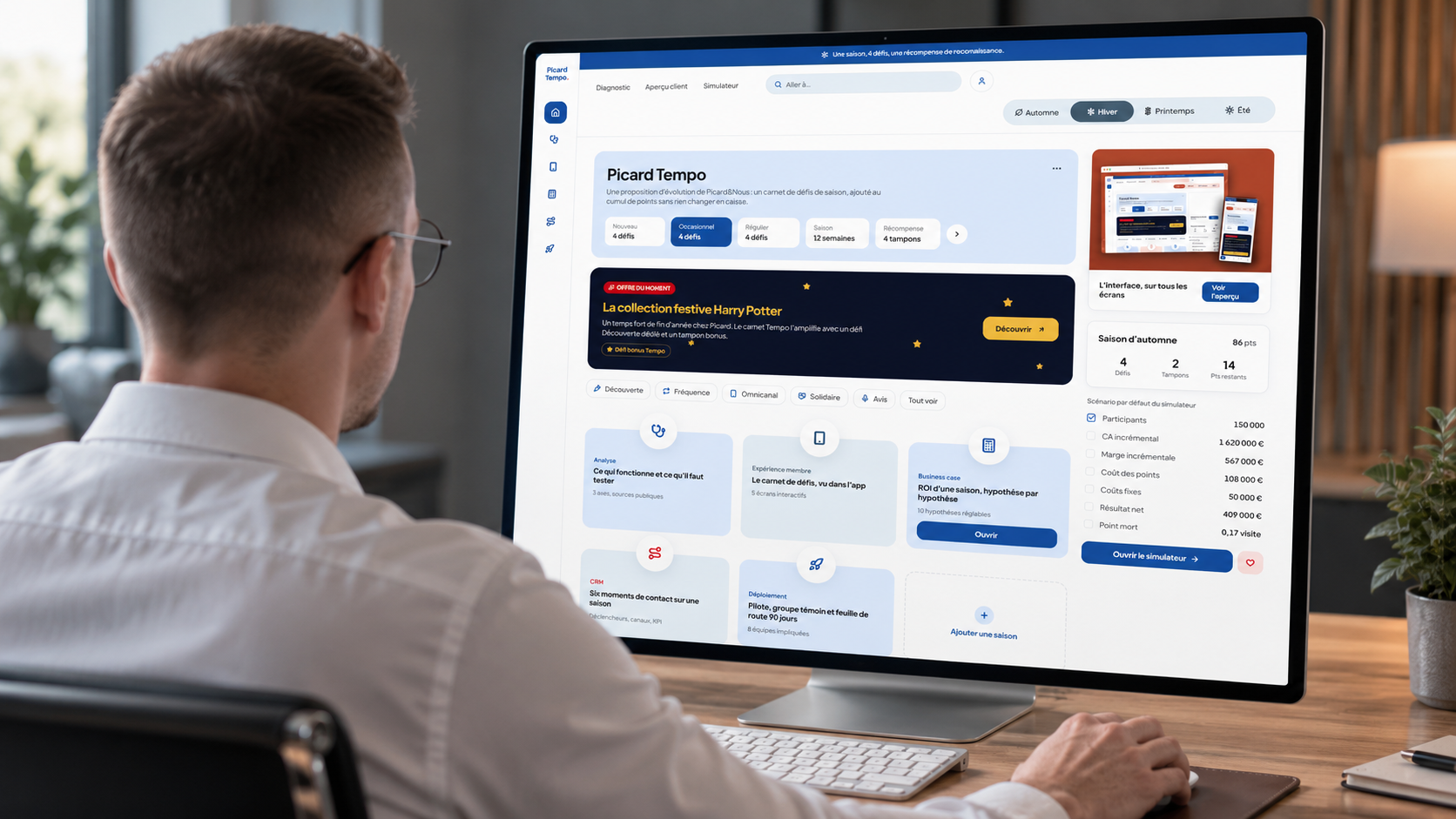
A light engagement layer on top of Picard&Nous: each season, four challenges over twelve weeks, with no change to points earning or checkout.
Concept / Prototype
An evolution proposal imagined as a personal project, not affiliated with Picard. Data and figures are illustrative, based on adjustable assumptions.
01
At a glance
A light engagement layer on top of Picard&Nous: each season, four challenges over twelve weeks, with no change to points earning or checkout.
5
interactive screens
10
adjustable assumptions
6
CRM moments
An evolution proposal imagined as a personal project, not affiliated with Picard. Data and figures are illustrative, based on adjustable assumptions.
Conception, art direction and implementation of the entire prototype (personal project).
02
Context & challenge
Picard&Nous works well: easy to join, nothing extra at checkout, and solid public results. It mainly rewards the amount spent. Regularity and discovery get little recognition, and the points reset on 31 January comes without any highlight. Picard Tempo starts from this observation.
What works
- Free, straightforward enrolment
- First threshold from 100 points
- Digital loyalty card
- Point donations to a food bank
Questions to test
- Points limited to one purchase per day and channel
- Points reset on 31 January
- Recognition for regular customers without a status tier
- Re-engaging occasional members
Indicators to verify
- Points redeemed for rewards
- Points expiring on 31 January
- Visit frequency by segment
- Loyalty email opens
- App adoption by store
Public programme results: card creations +50%, captured email addresses +150%, over 2 million customers at the first threshold. These are not Picard Tempo results. Method: built solely from public information; assumptions need recalibrating with the retailer’s data.
03
Concept · The challenge book
Each twelve-week season, members receive a book of four challenges, each tied to a business objective. The set adapts to the segment. A completed book unlocks a recognition reward, not a discount: it costs little and builds attachment.
- A book can be replayed four times a year, whereas a status is earned once.
- Nothing changes at checkout.
New member
4 challenges per segment · points and deadlines in the prototype
Occasional
4 challenges per segment · points and deadlines in the prototype
Regular
4 challenges per segment · points and deadlines in the prototype
Discovery
Try a new product, to broaden the basket
Frequency
Return three times in a month, for occasional shoppers
Omnichannel
First click & collect or app order
Solidarity
Donate points to a charity, for brand preference
Feedback
A 20-second voice review, for data and content
4 stamps · recognition
- · Preview of the seasonal collection
- · Cooking workshop
- · Vote for the next product
04
CRM journey
Start of season
One challenge book · 12 weeks
Season launch
- Trigger
- Start of season
- Channel
- Push, email, in-store display
- KPI
- Open rate and activation
First challenge completed
- Trigger
- Validated purchase
- Channel
- Push, till receipt
- KPI
- Challenge 1 completion
Mid-season reminder
- Trigger
- No completed challenge at D+30
- Channel
- Email by segment
- KPI
- Reactivation
Almost complete
- Trigger
- 3 stamps out of 4
- Channel
- Push
- KPI
- Completion
Recognition reward
- Trigger
- Completed challenge book
- Channel
- Email and app
- KPI
- Usage and NPS
Before 31 January
- Trigger
- D-30 and D-7
- Channel
- Email, push, opt-in SMS
- KPI
- Points redeemed and points expired
31 January
Store consistency
- Seasonal poster
- 15-second checkout pitch
- No additional checkout action
05
The business case, on your terms
From ten adjustable assumptions, the simulator calculates incremental revenue, points cost, windfall effect and break-even.
Assumptions need recalibrating with the retailer’s data.
Illustrative figures based on adjustable assumptions, not actual results
ROI simulator · Picard Tempo
Illustrative scenario
06
Rollout & measurement
The logical next step: a one-season pilot with a control group, then a roll-out decision based on engagement, activity and value criteria.
Engagement
Participation, completed challenges and books
Activity
Frequency and additional visits by segment
Value
Incremental revenue, margin and reward costs
W1–3
Scoping and data
W4–6
Specifications with Digital Factory and data; challenge selection with purchasing / promotions
W7–9
Development, acceptance testing and store training
W10–12
Pilot, measurement and recommendation
The first thirty days: listen, analyse data and prioritise the roadmap with customer marketing leadership.
07
Skills
Conception, art direction and implementation of the entire prototype (personal project).
08
Demo
The application in action
09
What it proves
A complete demo to prove the idea, not just a concept: a sourced diagnosis of the current programme, an interactive season-by-season app prototype, a six-moment CRM journey and an ROI simulator. The project demonstrates an approach, not actual commercial performance.
An evolution proposal imagined as a personal project, not affiliated with Picard. Data and figures are illustrative, based on adjustable assumptions.
Next project
Vauban Classic